


There’s a line between reassurance and negligence.
I crossed it.
And if I hadn’t kept going — if I had accepted what I was told — I’m not convinced I’d still be here.
That is not hyperbole.
That is my stone-cold truth.
The first blood test — and the lie of “normal”
My first testosterone test was taken in October 2019.
The result:
7.8 nmol/L
The clinical reference range printed beside it:
7.6 – 31.4 nmol/L
I was told, in writing:
“Your testosterone level is normal.”
That report exists. It is real. It is dated. It is signed.
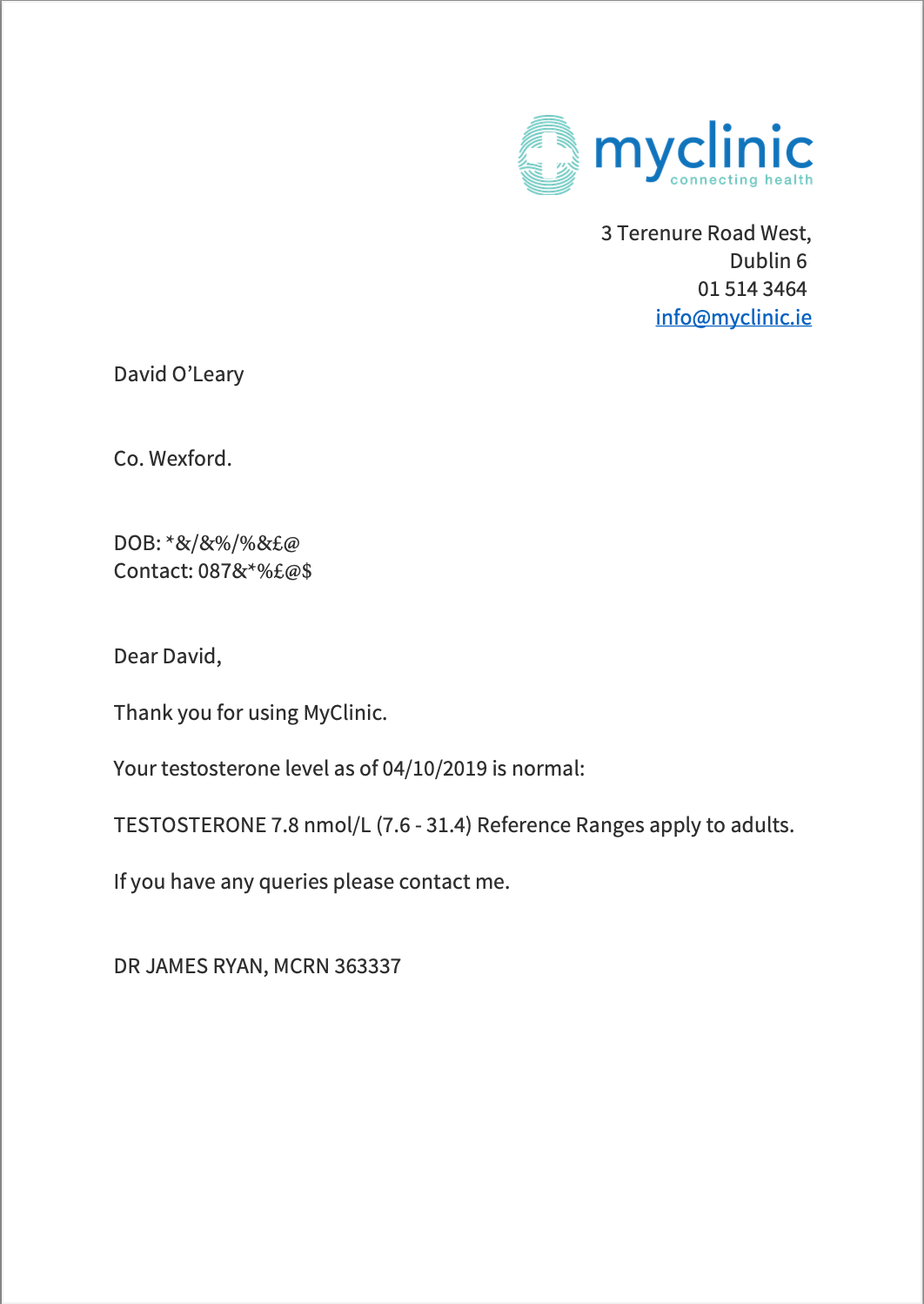
Let’s be absolutely clear about what that meant in practice:
I was 0.2 nmol/L inside the lower boundary
I was symptomatic
I was deteriorating
And I was reassured instead of investigated
Three years later, when I showed that same result to a consultant endocrinologist — now a professor — her reaction was immediate:
“Wow. That was very low.”
Not ambiguous.
Not debatable.
Very low.
That single sentence exposed everything that followed.
The second test — and the system closing ranks
After that first result, I did what patients are told to do.
I went back to my GP and requested another test.
That result came back higher:
13.64 nmol/L
Still not optimal.
Still inconsistent with how I felt.
But enough to muddy the waters.
So I asked for confirmation two months later — the most basic principle in endocrinology.
That’s when things turned ugly.
Instead of testing:
A nurse called in a doctor
I was talked out of the blood test
My €5 nurse fee was refunded
And I was effectively kicked out of the surgery
No investigation.
No curiosity.
No follow-up.
Just:
“You don’t need this.”
That wasn’t reassurance.
That was gatekeeping.
Understand what this does to a man
At this point, I was not well.
My nervous system was failing.
My endocrine system was failing.
My identity was fracturing.
And the system’s answer was:
“You’re fine.”
Do you understand the psychological violence of that?
When a man:
is losing regulation
is experiencing rage he doesn’t recognise
is collapsing on the floor
is questioning his value to his family
…and the authority he turns to tells him nothing is wrong, the conclusion is not relief.
The conclusion is:
“Then it must be me.”
That is where men disappear.
No pathway. No escalation. No responsibility.
Here is the part that needs to be said plainly.
At no point was I offered:
Endocrinology referral
Repeat morning testing protocol
SHBG or free testosterone assessment
Contextual interpretation of symptoms
Any structured follow-up whatsoever
The system did exactly one thing:
It checked whether I met the threshold for acute disease
When I didn’t, it shut down.
That is not healthcare.
That is administrative medicine.
Forced into exile for treatment
Only after being dismissed — repeatedly — did I contact a private clinic.
Not in Ireland.
Because there was no functional pathway here at the time.
In the UK.
Which meant:
Blood samples sent by post
Biohazard labelling
Time-sensitive courier services
Samples rejected for clotting or paperwork errors
Re-draws
Delays
Deterioration continuing in the background
While I was getting worse, I was managing logistics no sick man should have to manage.
This was not a convenience choice.
It was medical exile.
Let’s call this what it was
I am not picking a fight with medicine.
I am calling out a failure of responsibility.
The Irish medical system:
Relied on reference ranges instead of physiology
Treated testosterone as a binary disease marker
Ignored symptom severity
Actively discouraged further investigation
Left a deteriorating man to fend for himself
If I had accepted that verdict —
if I had stopped searching —
if I had believed the system over my body —
I may not still be here.
That is not rhetoric.
That is consequence.
Why I am saying this publicly
Because this isn’t about me anymore.
This is about the men who are:
being told they’re fine
being sent away
being pathologised psychologically
being denied investigation
and quietly losing themselves
This is not rare.
It is systemic.
And silence protects the wrong people.
Final truth — without apology
I did not become “anti-medicine”.
I became medically literate out of necessity.
I saved myself because no one else would.
And I will say this as loudly as required:
Male endocrine health in this country has been treated as an afterthought — and that is not good enough.
If that makes people uncomfortable, so be it.
Discomfort is cheaper than funerals.
DAVID